
Pearls of Trinco
2. Kazhagappulavar Pe. Po. Sivasekaram – A Father Figure in Trinco’s Education
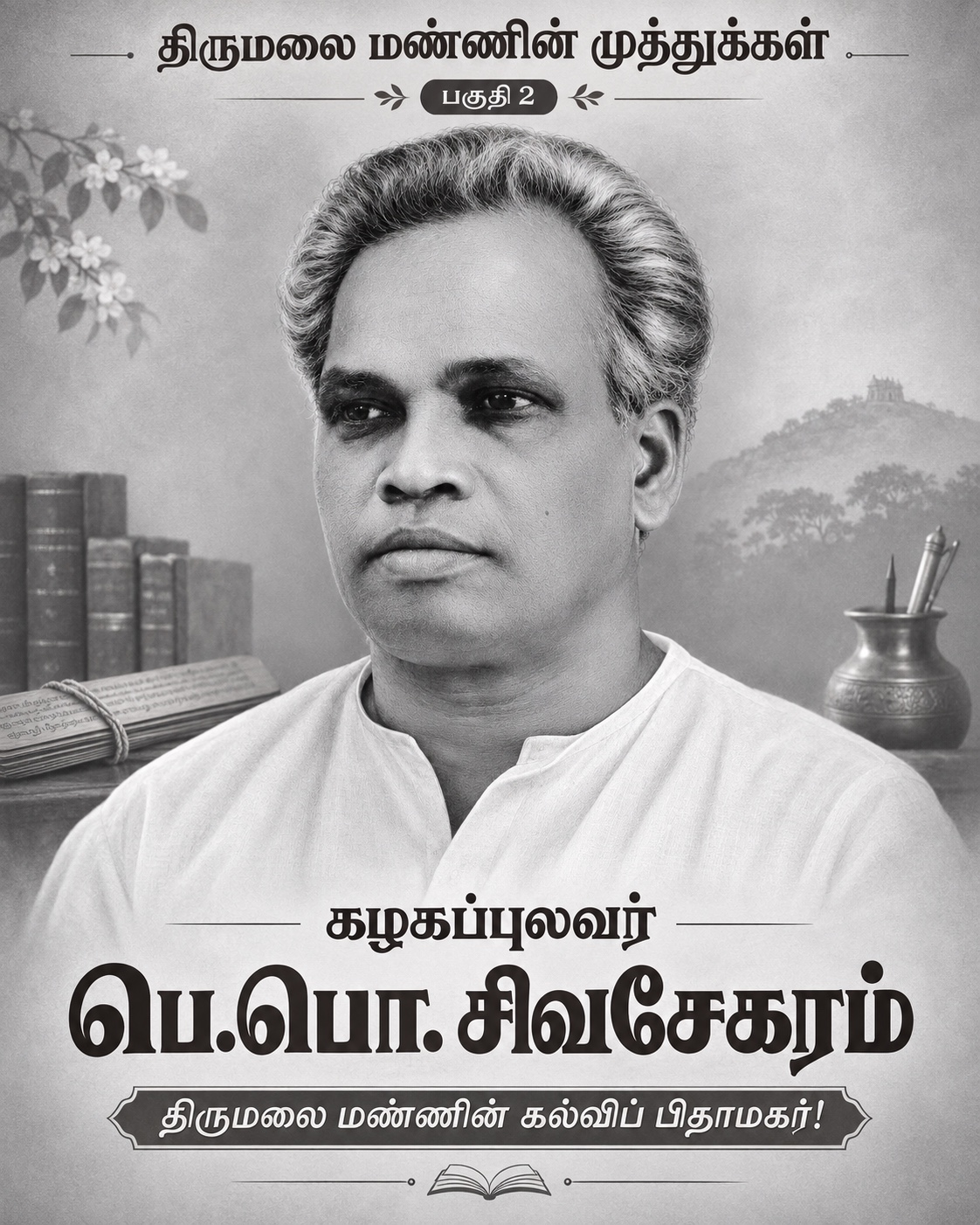
Pearls of Trinco!
In Trincomalee town, Rajavarothayam Road is the point where Peruntheru School and Shanmuga Vidyalayam meet. It was also where the respected Pe. Po. Sivasekaram lived. Having excelled in his own studies, he shared what he had learned with many young people from our town and helped them reach great heights in education.
Though he taught English, Tamil and mathematics, he was among those who helped nurture many Tamil pandits and scholars in Trincomalee. It is especially worth remembering that he never charged the students who came to him to learn Tamil.
Affectionately known in those days as Pe. Po. Si., he was honoured for his poetic talent at the Trincomalee Thiruvalluvar Kazhagam by Suddhananda Bharati, the Indian freedom fighter revered as a poet-yogi and maharishi. This is something we learned from our elders.
For many years he explained and taught the Thirukkural to earlier generations in Trincomalee. He made a major contribution to the growth of the Thiruvalluvar Kazhagam and, through it, helped keep Tamil learning alive.
As early as the 1950s, Sivasekaram was a lecturer at the Trincomalee Thiruvalluvar Kazhagam. He wanted his students to understand the meaning of the Thirukkural and the principles it offered for living, beyond learning its verses by heart and reciting them.
Alongside his command of Tamil grammar and literature, he had a distinctive gift for poetry. His poems were later collected in a 302-page volume titled Kazhagappulavar Pe. Po. Si. Kavithaigal, published by Eelathu Ilakkiya Solai in 1998.
His poems explored the Thirukkural, Kamban, Tamil, religion, nature and social life. Among them are ‘Eelathamil Naade’, ‘Eelathu Makkale’, ‘Konamalai’, ‘Ezhaiyin Kanneer’ and ‘Kamban Pugazh’. They show both his love for Tamil and his concern for the place he called home.
His service extended from Tamil to religious life. Among those contributions are the linked verses in the anthathi form that he composed in honour of Sri Pathirakali Amman of Trincomalee.
His devotional works ‘Kali Kavimalai’, ‘Thirukona Nayakar Oonjal’ and ‘Kathirkama Malai’ likewise bear witness to his devotion and his mastery of Tamil.
‘Vinai Theerkkum Villoonri Kandan’, which appeared in the 1994 consecration commemorative volume of the Villoonri Kandaswamy Temple in Trincomalee, was also his work.
He also served as a volunteer administrator at the Trincomalee branch of the Ramakrishna Mission, founded by Swami Vivekananda, a disciple of Ramakrishna Paramahamsa.
Alongside his work for Tamil and religion, he took an interest in the history of Trincomalee. He is understood to have researched how the name Thirukonamalai came into use.
All of this forms part of Sivasekaram’s service to Tamil, which began before I, a devotee of Siva, was born.
I was fortunate to get to know him as a boy. He had taught my father, and he lived near Saratha Street, where we lived. He often visited our home, and I had the chance to speak with him and get to know him.
In the early 1980s, the Trincomalee Kamban Kazhagam was formed through the efforts of Nadesapillai Vithiyatharan, former managing director of the Kalaikkathir newspaper. My father served as its president and Sivasekaram as its patron. That gave me the opportunity to know him better and learn from his detailed explanations of many verses from the Kambaramayanam.
At the time, the Katchi Padalam from the Sundara Kandam of the Kambaramayanam was part of the Tamil syllabus for Grades 9 and 10. The Trincomalee Kamban Kazhagam arranged special classes in Tamil grammar and the Kambaramayanam for students in those grades.
I still remember that each student who attended those classes was charged just 50 cents.
Through those classes, many of my generation had the chance to learn Tamil grammar and the Kambaramayanam directly from Sivasekaram, a father figure in education in our town.
Sivasekaram also took part in poetry gatherings, formal debates and discussions at the Trincomalee Kamban festivals organised through the efforts of N. Vithiyatharan and R. Balendranathan.
During breaks before and after those events, he would discuss and debate Tamil grammar and literature with Dr. Pon. Radhakrishnan, Vithuvan Velan, teacher Sivaramalingam, my father and Kambavarithi Jeyaraj. The knowledge he displayed in those conversations astonished me and gave me the chance to learn a great deal from him.
In those days, simply sitting nearby and listening when Tamil scholars gathered to discuss literature was an education in itself for young people like us.
When Sivasekaram explained verses from the Kambaramayanam, the way he brought out the grammatical features of the words and the literary beauty of the verses revealed the depth of his knowledge of Tamil.
Much of what I heard from him at that age remains with me. In particular, it was through spending time with scholars like him that I came to understand the difference between grasping what a verse means and appreciating its poetry.
His love of Tamil went beyond teaching students free of charge. In the early morning he would go to the homes of students who were still asleep, wake them and bring them along to teach them.
In those days, students usually went in search of their teachers. A teacher who went to his students’ homes and brought them to class deserves to be remembered for it.
It showed how deeply he cared about Tamil and how much he wanted his students to grow into knowledgeable people.
Today, when many see teaching as a profession and a source of income, remembering teachers like Sivasekaram, who devoted themselves to passing on what they had learned, helps us understand how deeply earlier generations valued education.
I wish to recall here that many graduates, professors and Tamil scholars who lived in Trincomalee received their education in their mother tongue from Sivasekaram himself.
He taught generations of students and took pleasure in sharing the knowledge of Tamil and the literary understanding he had acquired.
The pride of a place grows through the dedicated work of its teachers, Tamil scholars, poets and religious elders, as well as through the lives of the political leaders and wealthy people born there.
Kazhagappulavar Pe. Po. Sivasekaram stands among those distinguished people of our Trincomalee.
Wherever they live today, the students who benefited from his teaching, those who learned Tamil from him and those who knew him well will surely remember his love of Tamil and his dedication as a teacher.
By telling today’s generation about the lives and work of such people who lived and died in our town, we can pass on the history in which our community takes pride.
It gives me great joy, as a devotee of Siva, to remember the service of our senior teacher and distinguished Tamil scholar, Kazhagappulavar Pe. Po. Sivasekaram, to education, Tamil and religion, and to share my memories of knowing him personally and learning from his explanations of Tamil literature.
Swami Shankaranandaa 🙏
Reader Comments
Loading comments…