
ARTICLES · EELAM HISTORY
A Historical Account for Those Who Mock the Liberation Tigers While Forgetting the Atrocities of Sinhala Chauvinism!
Swami Shankaranandaa
When we speak of the atrocities Tamils suffered at the hands of Sinhala Buddhist chauvinism in Trincomalee District, many people recall only the ethnic violence of Black July in 1983. Yet the attacks and killings of innocent Tamils, and the burning of their homes and property in many parts of Trincomalee, both before and after that period, are not a history that can be forgotten.
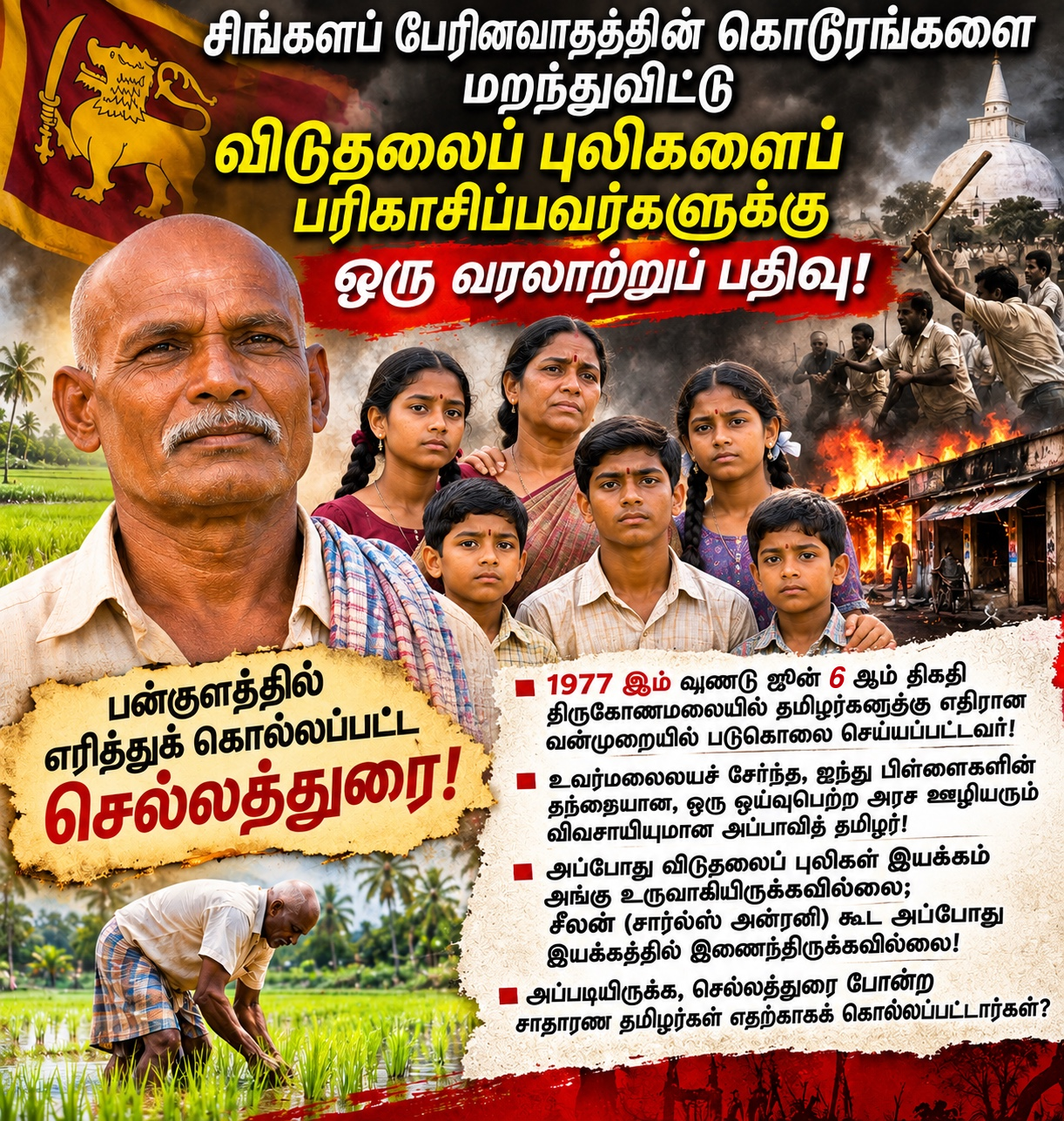
Among those atrocities, the oral testimony about the brutal killing of an innocent Tamil family man named Sellathurai in Pankulam, Trincomalee, remains in my memory to this day.
Sellathurai, a father of five from the Uvarmalai area of Trincomalee, was an ordinary working man who lived with his wife and children.
He was not someone competing for political power. He was not an armed combatant. Nor was he someone who wished to harm others. He was a retired government employee receiving a pension, and a farmer who worked to support his family.
He cultivated paddy fields in Pankulam, situated ten miles from Trincomalee town, and would usually travel there and stay to attend to his farming.
During one such weekend stay at his fields, following the arrival in Trincomalee on June 3, 1977, of the ashes of S. J. V. Chelvanayakam, known as Thanthai Chelva,
violence against Tamils in the Trincomalee area had intensified through government instigation and with the cooperation of Sinhala forces.
Sinhala racist mobs attacked Tamil homes and businesses. Tamil-owned shops were set on fire.
Tamil civilians were assaulted. Women, children and elderly people were left in an unsafe situation.
Amid that terrible situation, on June 6, 1977, Sellathurai was cycling back to his home in Trincomalee from Pankulam, where he had been staying, when he fell into the hands of a violent Sinhala mob.
The Sinhala attackers seized him, a man who had gone to work in his fields, severely beat him, cut off his hands and legs, placed him with sacks of paddy and set them on fire, burning him to death.
Dear friends!
If beating a person to death is itself an atrocity, consider for yourselves the depth of inhumanity involved in setting him on fire and killing him.
For whom had that man worked? For his wife and five children, had he not?
Who can make up for the loss suffered by a family that had expected their father to return home from the fields?
Those cruel Buddhist Sinhala chauvinists destroyed not only a father's life, but also a family's security and hope for the future.
This was not merely one family's tragedy. There are thousands of painful incidents showing how Tamils who suffered such atrocities were made unsafe in their own homeland.
At the time when these atrocities and attacks against Tamils took place in Trincomalee, the Liberation Tigers of Tamil Eelam had not yet emerged there.
Even Charles Anthony, known as Seelan, who later became the Liberation Tigers' first attack commander, had not joined the movement at that time.
Why, then, were innocent Tamils attacked?
Why were ordinary farmers such as Sellathurai brutally killed?
Was it because they were Liberation Tigers? Or because they were Tamils?
While covering up and defending the killings of Tamil people by Sri Lanka's Buddhist chauvinist government and its security forces, which inflicted such atrocities on Tamils,
paramilitary groups seeking to brand as fascist the Liberation Tigers, who emerged from those injustices and fought against them, and individuals who are hostile to Tamil national politics, should stop speaking as though they were enlightened humanitarians.
Before criticising the Tigers, who are no longer in the field, and the armed struggle they waged, they should learn about the ethnic violence inflicted on innocent Tamil people by Sinhala Buddhist chauvinism and understand the historical background that led to the growth of the Tamil armed struggle.
They must recognise the historical truth that the denial of Tamils' political rights by Sinhala Buddhist chauvinism, the failure of non-violent struggles to yield results, and the lack of protection for Tamil lives and property led to the emergence of armed struggle.
I state emphatically that all those who hesitate to place on the historical record the truth that the Sinhala chauvinists who have long governed Sri Lanka, a country of Buddhist supremacy, were responsible for the emergence within a peaceful society of a militant organisation such as the Liberation Tigers, are lackeys of Sinhala interests who bring no benefit to the Tamil national cause, and black sheep serving those interests.
Reader Comments
Loading comments…