
ARTICLES · EELAM HISTORY
The Door to Geneva Opened by Mullivaikkal Is Closing Because of Disunity Among Tamil Diaspora Organisations!
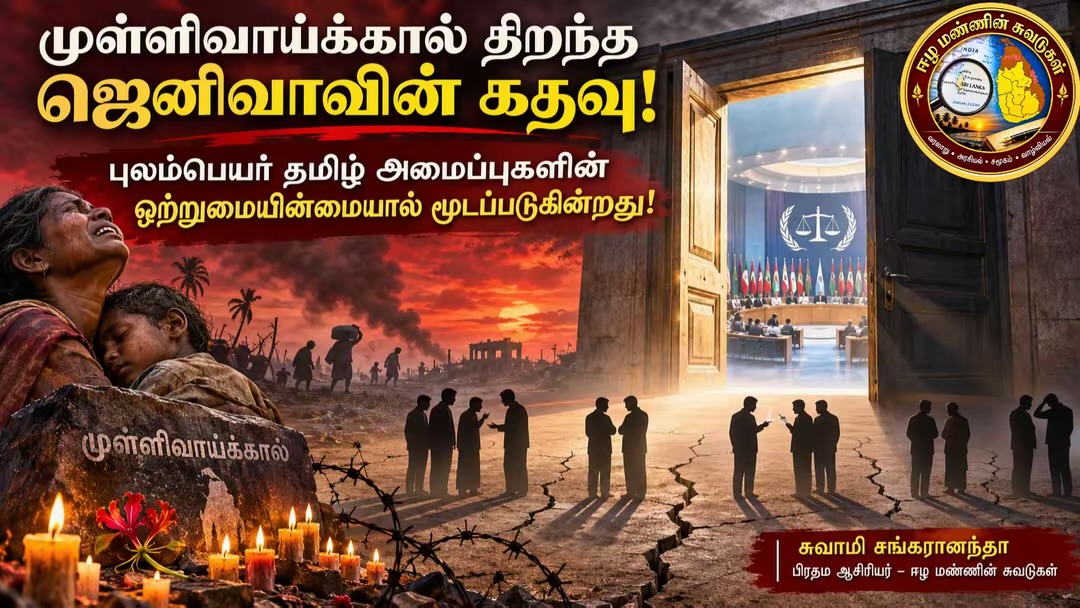
Swami Shankaranandaa
Editor-in-Chief – Eelam Mannin Suvadugal
When the armed struggle of the Liberation Tigers of Tamil Eelam came to an end at Mullivaikkal in May 2009, our Eelam Tamil people, who had suffered thousands of deaths and immense devastation, found a new opportunity after that final war to seek international justice in Geneva.
Had Tamil diaspora organisations united and properly used that opportunity, they could have strengthened the struggle for the political rights of Eelam Tamils today. It is deeply regrettable, however, that disunity among those diaspora organisations continues to weaken that historic opportunity.
The deaths of more than 30,000 Maaveerar, the devastation suffered by hundreds of thousands of innocent Tamil people, and the anguish of several thousand forcibly disappeared people together created a situation in which Eelam Tamils had to seek justice before the nations of the world.
Had Tamil diaspora organisations united and properly used this historic opportunity, they could have further strengthened international support for Tamil political rights and created a political environment capable of opening the door to Tamil Eelam as well.
But now, seventeen years later, it is my firm opinion as a Tamil nationalist that leadership rivalries, policy disagreements and separate political activities among Tamil diaspora organisations have weakened the historic opportunity our people received.
Dear friends!
When discussing the history of the Tamil Eelam liberation struggle, first understand clearly the historical truth that this struggle was not begun by the Liberation Tigers.
Following independence from the British Empire in 1948, Buddhist chauvinism that emerged in the country then called Ceylon first brought about laws affecting the citizenship and voting rights of the Hill Country Tamils.
In 1956, the government led by S. W. R. D. Bandaranaike passed legislation making Sinhala the sole official language.
When members of the Ilankai Tamil Arasu Kachchi, led by Thanthai Chelvanayakam, launched non-violent protests against this, Tamils taking part in peaceful protest in Colombo were attacked by Buddhist chauvinists. This was followed by widespread ethnic violence and massacres against Tamils in Gal Oya and many other areas.
In 1958, Tamils were killed again. Homes and property were destroyed. Thousands of people were forced to leave their places of residence.
Even after all these atrocities, Tamil political leaders continued trying to obtain a solution through peaceful means.
Although the Bandaranaike–Chelvanayakam Pact was reached in 1957, it was abandoned because of opposition from Sinhala Buddhist chauvinists.
In 1961, the Sri Lankan government again used the military to suppress the satyagraha campaign organised by the Ilankai Tamil Arasu Kachchi in the North and East.
The principal promises of the Dudley Senanayake–Chelvanayakam Pact reached in 1965 were also not fulfilled.
The new constitution introduced on May 22, 1972, changing the country's name from Ceylon to Sri Lanka, gave primacy to Buddhism and the Sinhala language and failed to address Tamil political demands.
In these circumstances, the Vaddukoddai Resolution was adopted on May 14, 1976, at the Tamil United Liberation Front convention held under the leadership of Thanthai Chelvanayakam.
The political demand for the establishment of an independent Tamil Eelam was put forward there.
It was not the Liberation Tigers who adopted that resolution. It was the Tamils' parliamentary political leadership that had advanced the demand for a separate Tamil Eelam state.
The continuing ethnic oppression by Sri Lankan governments, the disregard shown to peaceful Tamil protests and the failure to implement political agreements were major factors that pushed Tamil youth towards armed struggle.
Although some armed groups began to emerge here and there among Tamil youth in the 1970s, the Tamil New Tigers, formed under the leadership of Velupillai Prabhakaran, was renamed the Liberation Tigers of Tamil Eelam on May 5, 1976.
Tamils faced successive attacks: the anti-Tamil violence of 1977, the burning of the Jaffna Public Library in 1981 and the Black July massacres of 1983.
The repression thus imposed on Tamils by the Sinhala Buddhist chauvinist state caused the Tamil armed struggle to expand greatly.
Without discussing the Sinhala Buddhist chauvinist state and its brutal politics that gave rise to the Liberation Tigers, paramilitary groups and individuals opposed to Tamil nationalism conceal that history and create the illusion that the Liberation Tigers themselves caused Sri Lanka's ethnic problem, planting a false history within today's Eelam Tamil society.
Tamil national organisations in diaspora countries, which should unite against such concealment of the fundamental causes of the Tamil rights struggle, are instead creating rivalry and jealousy among themselves, acting against one another and, without realising it, committing a grave betrayal of the Maaveerar who died for the Eelam struggle and of the Eelam Tamil people.
Until the Liberation Tigers' armed struggle was brought to an end at Mullivaikkal in 2009, organisations that acted in unity at the slightest movement of the index finger of the Liberation Tigers' leader, His Excellency Prabhakaran, now clash with one another over who is greater. They have shattered and fragmented Tamils both in Tamil Eelam and in the diaspora,
allowing traitors, enemies of the Tamil people and contemptible sycophants who live by flattery to flourish.
Dear friends, it is still not too late.
In this Maaveerar month, let us pledge to unite, recognising that the important responsibility of bringing the killing of civilians, attacks on hospitals, the fate of those who surrendered, enforced disappearances and allegations of war crimes during the final stages of the war before international investigations belongs not only to Tamil national organisations in diaspora countries, but to everyone who loves that land, its people and the Maaveerar.
Dear friends!
Although a resolution favourable to the Sri Lankan government was adopted at the special session of the United Nations Human Rights Council in May 2009, the subsequent changes in the international arena are significant.
In 2011, the report of the Panel of Experts appointed by the United Nations Secretary-General was released.
In 2012, a resolution on reconciliation and accountability in Sri Lanka was adopted.
In 2014, steps were taken that paved the way for an international investigation.
In 2015, the Office of the United Nations High Commissioner for Human Rights released its comprehensive investigation report.
The resolution adopted in 2021 strengthened efforts to collect and preserve evidence relating to serious human rights violations committed in Sri Lanka.
The resolution adopted on October 6, 2025, further extended those activities.
The Sri Lanka issue was also taken up at the 63rd session of the United Nations Human Rights Council on September 8, 2026.
Therefore, without further delay, let us, as diaspora Tamils, unite and make Buddhist Sinhala chauvinist oppression a focus of discussion so that Sri Lanka's ethnic problem and the injustices inflicted on Tamils can be debated in the international arena.
Let us demonstrate the strength of our communities living in Canada, Britain, France, Germany, Switzerland, Norway, Australia, the United States and other countries, in accordance with the laws of those countries.
As diaspora Tamils maintain relationships with political parties, members of parliament and human rights organisations in the countries where we live, let us use those opportunities for this purpose as well.
Rather than using Maaveerar events and commemorations as publicity or commercial occasions, let us remember those who died for our people's liberation and launch a signature campaign demanding the lifting of the ban on the Liberation Tigers, enabling political activity in the homeland and the diaspora.
Let us recognise that this can certainly be achieved if all Tamil diaspora organisations unite and work under a common political programme.
Just as organisations including the Australian Tamil Congress, the British Tamils Forum and the United States Tamil Action Group jointly called in 2021 for the United Nations Human Rights Council resolution on Sri Lanka to be strengthened,
and just as several North American Tamil organisations jointly wrote to member states of the United Nations Human Rights Council in August 2025 concerning Tamil self-determination and international accountability,
let all organisations in diaspora countries unite, mobilise the people and advance the demand to lift the ban on the Liberation Tigers, at least on this Maaveerar Day.
During this sacred month of the Maaveerar, let us work together to turn such coordinated efforts into a permanent common political structure bringing together all Tamil diaspora organisations.
Although every organisation has the political right to choose its own path, let us recognise the reality that our failure to develop a coordinated position on the common national rights of Eelam Tamils weakens our strength as Eelam Tamils in political negotiations with the international community.
Let representatives of Tamil diaspora organisations unite and conduct political negotiations with the international community on the basis of common demands concerning the historical injustices underlying the Tamil ethnic problem, the right to self-determination, justice for the devastation at Mullivaikkal, the forcibly disappeared and the land rights of Tamils in the North and East.
If we change the situation in which there is one position in Canada, another approach in Britain and different activities in Europe, and develop a common position at least on fundamental Tamil political rights and demands for international justice, we can also influence Tamil politics in the homeland.
Tamil national political parties in the North and East stand divided into different camps. It is noteworthy that the Ilankai Tamil Arasu Kachchi, the All Ceylon Tamil Congress, the Democratic Tamil National Alliance and independent groups contested separately in the Jaffna electoral district at the 2024 parliamentary election.
That election reflected both public dissatisfaction with traditional political leadership and the emergence of new political figures.
Diaspora organisations can change this division!
We Tamils living in the diaspora can do so too!
Let us create a common programme centred on the political rights of Tamils in the homeland.
By prioritising the views of people living in the homeland and families affected by the war in international efforts to secure Tamil political rights, let us, as diaspora Tamils, bring an end to their suffering and use the door to Geneva opened by Mullivaikkal as a path for the Eelam Tamil people's journey towards their ideal.
Reader Comments
Loading comments…