
ARTICLES · EELAM HISTORY
Forty-One Years Since Muslim Gunmen Took the Lives of 40 Tamils in Karaitivu!
Swami Shankaranandaa
Editor-in-Chief, Eelam Mannin Suvadugal
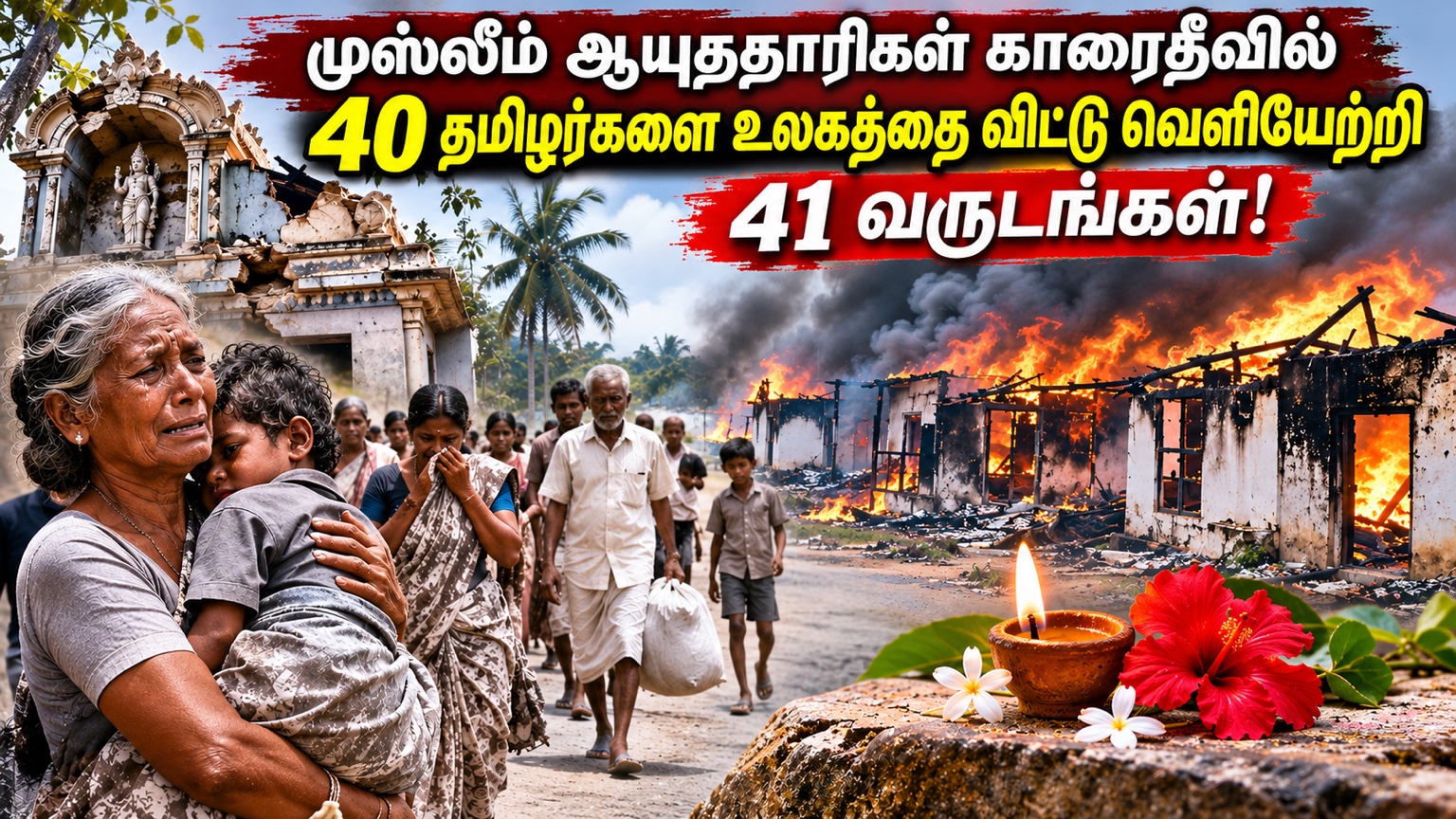
This past April marked 41 years since the three days of attacks that began on April 12, 1985, when Muslim gunmen, backed by members of the Sri Lankan Police Special Task Force, attacked the Tamil village of Karaitivu in Sri Lanka’s Ampara District.
The people of Karaitivu were preparing to celebrate the Tamil New Year when they came under brutal attack in their own homeland from April 12 to 14 that year.
Forty Tamils were killed in these attacks by armed Muslim groups, and hundreds of homes, businesses and temples were destroyed. Thousands were forced from their homes and became refugees.
Karaitivu, one of Ampara District’s oldest Tamil villages, lies near areas with large Muslim populations, including Kalmunai, Sainthamaruthu, Maligaikadu, Nintavur and Sammanthurai.
The birthplace of Swami Vipulananda, Karaitivu had a distinct history of education, farming, fishing, trade and religious worship.
The Tamils of Karaitivu and the Muslims of neighbouring villages had longstanding commercial and social ties.
Karaitivu residents routinely travelled to Muslim trading areas, including Kalmunai, to buy everyday goods.
On the morning of Friday, April 12, 1985, Tamils travelling from Karaitivu to Kalmunai to buy supplies for the Tamil New Year were attacked by armed Muslim groups near the Maligaikadu junction.
Although police and Special Task Force personnel were present, they took no action to protect the Tamils under attack.
At around 2 p.m. that day, an armed Muslim mob of about 800 entered Karaitivu with guns, petrol bombs, knives and other weapons. They attacked Tamil homes and businesses along the main road, broke into houses, looted valuables and then set the buildings on fire.
Shocked by the sudden attacks, Tamil residents fled with their children and elderly relatives. I draw the attention of the self-styled neutrals who accuse the Liberation Tigers of ethnic cleansing for expelling Muslims to the fact that homes lived in for generations and possessions earned through hard work were burned before the residents’ eyes. I also record that Karaitivu’s historic Kannagi Amman Temple was attacked on the first day. Part of the temple was burned and its perimeter wall was damaged.
The attacks on Karaitivu continued for a second day on Saturday, April 13.
People who escaped the first day’s attacks had taken shelter in schools and other places of safety. Gunfire and explosions were heard again that morning.
That day, armed groups numbering about 500 entered Karaitivu from three directions.
One group entered via the Kalmunai–Pottuvil main road and attacked homes and shops. Another continued the attacks from the northeast, where the Sithanaikkutti Swami Temple stands. A third attacked the Mayilvaganam Road area.
Gunmen broke into Hindu temples, smashed statues of deities and took valuables. The mob loaded goods from houses and shops onto trucks and then set the buildings on fire.
Several Tamils were killed in the attacks that day. Sacks of paddy that Tamil farmers had harvested and stored were also burned. Residents lost their livelihoods along with their homes and businesses.
On Sunday, April 14, the Muslim gunmen continued their attacks on Karaitivu for a third day.
At around 8 a.m., amid explosions, Muslim gunmen came ashore in fishing boats and entered the eastern part of Karaitivu.
In Karadithottam and other areas, they attacked homes, shops, rice mills, pharmacies, fishing equipment and government institutions. They also damaged temples dedicated to Ganapati, Veerabhadra and other deities.
On the third day, two government schools and a preschool were damaged. Eighteen fishing boats and fishing equipment were burned.
Over the three days, about 40 Tamils were killed. Many more were injured or made to disappear. The hospital, pharmacies, schools, fishing boats, farm machinery, motor vehicles and bicycles were destroyed, and large numbers of livestock were lost.
Thousands of Tamils who lost their homes and belongings in this rampage by armed Muslim groups backed by Special Task Force personnel took refuge in schools and temporary camps. They were forced to depend on others for food, clothing, drinking water, medicine and other basic necessities.
What happened in Karaitivu went beyond a sudden clash between two communities.
It was a three-day assault on Tamils, carefully planned by Muslim gunmen who gathered in mosques.
The brutal actions of these Muslim gunmen deeply damaged relations between Tamils and Muslims.
Every Muslim who accuses the Liberation Tigers of ethnic cleansing should recognise that Muslim people themselves supported the Muslim gunmen who carried out the attacks.
In 1990, after discovering a Muslim group that had conspired with the Sri Lankan Army, the Liberation Tigers expelled Muslims without inflicting bodily injury on those they expelled.
Later, at a press conference in 2001, national leader Velupillai Prabhakaran and Anton Balasingham, the father of the nation, expressed regret for the expulsion and said that those expelled could return once the situation settled.
What is deeply regrettable is that no Muslim leader issued even one statement condemning the Islamist gunmen who killed Tamils over several decades, beginning in Karaitivu in 1985, or expressed any regret.
Swami Shankaranandaa
Editor-in-Chief, Eelam Mannin Suvadugal
Reader Comments
Loading comments…