
ARTICLES · EELAM HISTORY
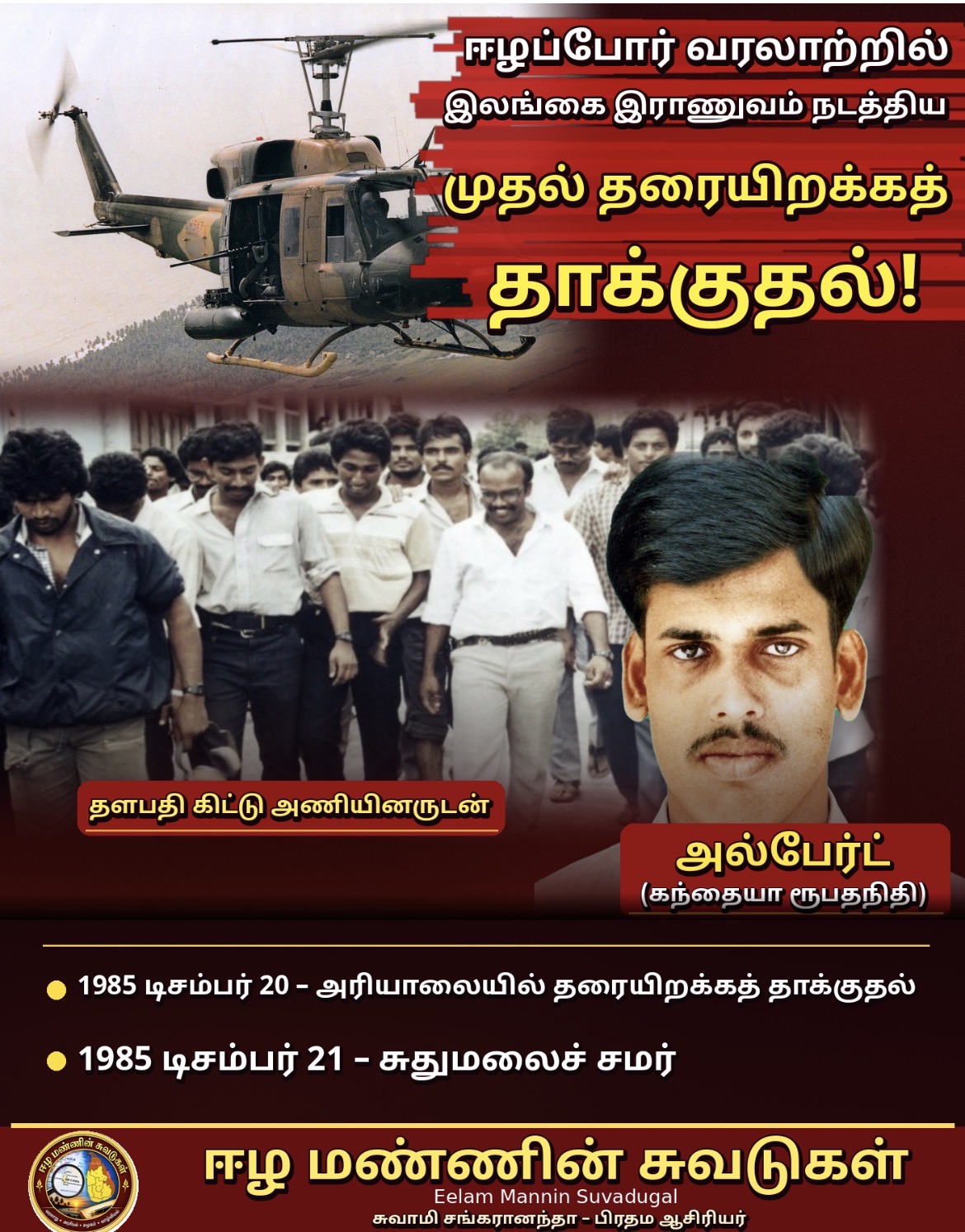
The Sri Lankan Army’s First Helicopter-Borne Assault in the Eelam War!
Swami Shankaranandaa
Editor-in-Chief – Eelam Mannin Suvadugal
In the early 1980s, Sri Lanka’s three armed services and police hunted down Tamil Eelam fighters and Tamil civilians. Unable to contend with the fighters’ counterattacks, they began to shift from ground assaults to aerial attacks in their efforts to locate and strike the fighters.
By mid-1985, such aerial attacks had intensified across much of Jaffna District. Sri Lankan Air Force helicopters opened fire on fighters and civilians alike.
Helicopters fired on vehicles suspected of carrying fighters as well as on vehicles carrying civilians, including flatbed vans and minibuses.
On 20 December 1985, the Sri Lankan Army targeted Nadaveedu, a camp of the Liberation Tigers of Tamil Eelam (LTTE) in Ariyalai, Jaffna. For the first time, it launched a new operation using helicopters to land troops, surround the camp and attack it.
The operation aimed to surround and eliminate the LTTE fighters stationed at Nadaveedu. Because the army’s intelligence was inaccurate, its troops landed some distance from the camp.
The troops could not surround and attack the camp as planned and had to face a counterattack by the LTTE unit stationed there.
Unable to withstand the counterattack or reach their objective, the troops began to withdraw.
During the attack, however, the troops killed Rasappu Uthayakumar, an LTTE fighter known by the nom de guerre Karthik. They took his weapon and withdrew on foot along the railway line to the Navatkuli army camp.
Subaskaran Rajendran, an 18-year-old who worked at a bakery in Ariyalai, was killed in the attack.
Subramaniam Ranjithamalar and Jeeva Amma, the wife of Subramania Iyer, the priest at Ariyalai’s Kottukkinatru Pillaiyar Temple, were also injured.
Having failed to achieve the expected result in Ariyalai, the Sri Lankan Army sought to reverse that setback by launching another helicopter-borne assault early the next morning, 21 December 1985, in Suthumalai, Jaffna.
Suthumalai housed the headquarters of Kittu, the LTTE’s Jaffna district commander. Nearby stood Nages Amman’s subsidiary camp, known as Number 3.
Among the fighters staying at these camps were Jony, Pappa, Rahim, Oothai Ravi, Shanmugam, Thileepan, Idea Vasu, Kutty Sri, Nixon, Arunan, Kiruba, Sathya and Chandran. A tiger cub raised by Kittu was also at the camp.
Early on 21 December 1985, the Sri Lankan Army arrived in Suthumalai with the support of three helicopters and began an operation to surround and attack the LTTE camps under Kittu’s command.
Two helicopters suddenly landed a short distance from the Suthumalai camp, dropped off troops and took off again.
The troops carried modern weapons, including AK-pattern rifles, light machine guns, rocket-propelled grenades and mortars.
The LTTE fighters at the camp had only weapons such as submachine guns, repeating rifles, .303 rifles and hand grenades.
As the troops advanced towards the camps, Pappa opened fire, marking the beginning of the Battle of Suthumalai.
Within a minute or two of the landing, gunfire broke out close to the camp and a fierce clash ensued.
Faced with the unexpected assault, Kittu directed the counterattack, giving clear, firm orders and encouraging his fighters.
At the same time, he used a handheld radio to contact nearby LTTE camps and call fighters to Suthumalai.
He directed the arriving fighters to attack the troops from different directions and used the limited weapons at his disposal to halt the army’s advance.
The LTTE counterattack against the troops who had landed in Suthumalai lasted three to four hours.
Unable to withstand the counterattack led by Kittu, the troops suffered heavy losses and began to withdraw by helicopter.
During the fighting, Albert, a senior LTTE member named Kandiah Roopathaneethi, received word at another camp that the LTTE camp in Suthumalai had been surrounded. He rushed there with his unit to help.
On their way from Achchuveli, Albert and his unit escaped gunfire from helicopters, reached Suthumalai and joined the fighting against the army.
By then the troops, unable to withstand the LTTE counterattack, were attempting to board the helicopters and withdraw.
On Kittu’s orders, Albert and his unit attacked from behind in an attempt to prevent the troops from withdrawing.
The withdrawing troops directed heavy gunfire at Albert’s unit.
Albert suffered a severe wound below his left eye. He died from the injury in the Battle of Suthumalai.
Before the fighting ended, some members of the Tamil Eelam Liberation Organization (TELO), led by Alex, also arrived in Suthumalai to support the LTTE.
Tamil Eelam fighters from Jaffna, Manipay, Kokuvil, Thavady and other areas also took part in field duties according to their abilities and experience.
The army’s helicopter-borne assault targeted the LTTE camps in Suthumalai, but the Sri Lankan Air Force’s helicopter attacks that day extended beyond Suthumalai.
Helicopters opened fire across several areas of Jaffna, including Uduvil, Sanguveli, Manipay, Thavady and Kokuvil.
Two people, including a nine-year-old boy, were killed in the Air Force attacks.
Those injured included Navaretnarajah Thangaranee of Manipay, Chinnarasa Sarveswari and Chellathurai Sivapakiyam of Kokuvil West, and three more people from Sanguveli.
On 20 December 1985, after landing by helicopter in Ariyalai, the troops withdrew on foot to the Navatkuli camp following the LTTE counterattack.
The next day, on 21 December, troops who landed in Suthumalai came under a fierce counterattack led by Kittu and withdrew by helicopter.
The two assaults over two days show that the Sri Lankan Army failed to achieve its principal objectives in either operation. At Suthumalai, the LTTE fighters’ counterattack with limited weapons against troops landed by helicopter and equipped with modern arms, and the way Kittu led it, stand out.
Had the commando assault succeeded, the Sri Lankan Army might have been encouraged to repeat similar attacks on LTTE camps elsewhere.
After the assault at Suthumalai was repelled, however, the Sri Lankan Army showed little inclination to continue operations of the same kind.
In the author’s view, the principal reason was the courage, judgement and leadership that Kittu showed in the Battle of Suthumalai.
Rasappu Uthayakumar, known as Karthik, fell in the first attack at Ariyalai. Kandiah Roopathaneethi, known as Albert, fell in the second attack at Suthumalai.
The withdrawal on foot from Ariyalai and the withdrawal by helicopter from Suthumalai illustrate the strength of the LTTE’s military operations at the time.
The Sri Lankan Army used modern weapons and helicopter-borne troops in both assaults. The LTTE’s repulse of the two attacks remains a memorable episode in the early history of the Eelam War.
Reader Comments
Loading comments…