HISTORY OF THE EELAM STRUGGLE · EDITORIAL
Thileepan’s Death After His Hunger Strike and the Indian Congress Government’s Response!
Dear friends,
September 1987 remains an unforgettable period in the history of the Eelam Tamil liberation struggle.
Thileepan, who began a hunger strike in Nallur, Jaffna, putting forward five demands to the Congress government led by then Indian Prime Minister Rajiv Gandhi, died on its twelfth day.
Who was Thileepan?

Rasiah Parthipan, born on November 29, 1963, established contacts with the Liberation Tigers and acted as a supporter while studying at Jaffna Hindu College.
After the Thirunelveli attack of July 23, 1983, and the Black July violence that followed, he, although qualified to study medicine, joined the Liberation Tigers and became known as “Thileepan.”
He later served as the political division head for Jaffna District, engaging in political contacts with the people and in public events.
July 29, 1987 – The Indo–Sri Lanka Accord
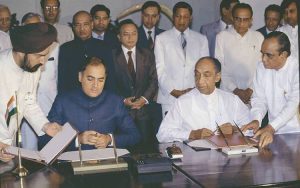
The Indo–Sri Lanka Accord was signed on July 29, 1987, by Indian Prime Minister Rajiv Gandhi and Sri Lankan President J. R. Jayewardene.
Its principal objectives were to address the ethnic conflict, establish peace in the North and East, and advance the sharing of political power.
But as no political party or liberation movement representing Eelam Tamils signed that accord, the Indian government led by then Prime Minister Rajiv Gandhi took on the moral responsibility of safeguarding the interests and security of Eelam Tamils.
Although the Indian Peace Keeping Force was sent to the North and East after the accord, problems concerning the release of political prisoners, settlements, and military and police operations continued.
September 13 – The Five Demands
Against this background, five demands were submitted to the Indian High Commissioner on September 13, 1987:
- Release Tamil political prisoners.
- Stop planned Sinhala settlements in the North and East.
- Suspend rehabilitation activities until an Interim Administrative Council is established.
- Stop building new police stations in the North and East.
- Disarm the Home Guards and withdraw the military and police stationed in Tamil areas.
September 15 – The Hunger Strike in Nallur
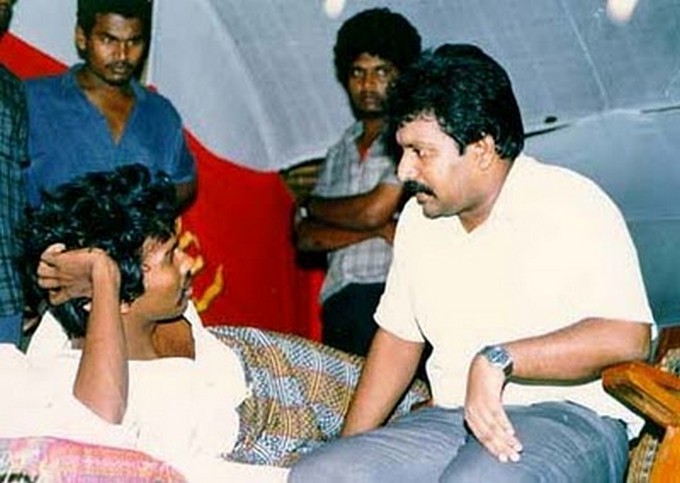
When no satisfactory response to the demands was received, Thileepan began a hunger strike near the Nallur Kandaswamy Temple on September 15.
He was only 23 years old at the time.
He continued the protest without taking food or even water. Students and members of the public from many parts of the North and East gathered in Nallur to show their support.
As the days passed, his health deteriorated. Talks took place between the Indian side and the Liberation Tigers, but no agreement was reached.
A Protest That Drew International Attention
As Thileepan’s condition deteriorated, diplomats from Norway, Sweden, Britain and Australia went to Nallur to see him.
His protest thus drew the attention of international diplomatic circles.
But despite the demands having been submitted to the Indian High Commissioner, no one from the Indian side came to see Thileepan in person. No resolution was reached even after the visits by the foreign diplomats.
The Indian Congress Government’s Approach
Talks were held between the Congress government led by Rajiv Gandhi and the Liberation Tigers.
In his later memoirs, Indian High Commissioner J. N. Dixit explained that he was unwilling to meet Thileepan in person because he had not received an assurance that Thileepan would end his hunger strike.
As differences between the two sides persisted, Thileepan’s health continued to deteriorate.
September 26 – Thileepan’s Final Day
The hunger strike that began on September 15 came to an end on September 26, its twelfth day.
Thileepan died at about 10:48 that morning.
His death caused profound grief and political reactions in Tamil areas. In accordance with his final wish, his body was handed over to the medical faculty of the University of Jaffna.
What Happened Afterwards?
Following Thileepan’s death, distrust between the Indian government and the Liberation Tigers intensified further.
Among those arrested by the Sri Lankan navy were Pulendran Amman, the Trincomalee District commander, and Kumarappa, the Jaffna District commander.
On October 5, 1987, as they were due to be taken to Colombo, they took cyanide and died, further worsening the situation.
Direct armed clashes then began between the Indian Peace Keeping Force and the Liberation Tigers of Tamil Eelam.
Questions Raised by History
Thileepan’s hunger strike and death cannot be seen merely as the life story of an individual.
It was a pivotal historical moment at which the political hopes created by the 1987 Indo–Sri Lanka Accord, unresolved problems, the Indian government’s responsibility, and the position of the Liberation Tigers all converged.
Why was no resolution found for the five demands?
Why did no political agreement emerge to bring the twelve-day hunger strike to an end?
Why was no diplomatic solution reached even after diplomats from four countries came to see him?
These questions did not end with Thileepan’s death.
They remain historical questions that must be examined today to understand the political events of 1987 and the subsequent changes in relations between India and the Liberation Tigers.
Therefore, rather than stopping at commemorating Thileepan’s name, everyone concerned with a political solution for Eelam Tamils needs to examine and understand the political setting in which his demands arose, why they were not resolved, and the political and military changes that followed.
Swami Sankarananda 🙏
Reader Comments
Loading comments…