
Satire / Opinion
Those Who Imagined Themselves Kings with the Lions’ Support!
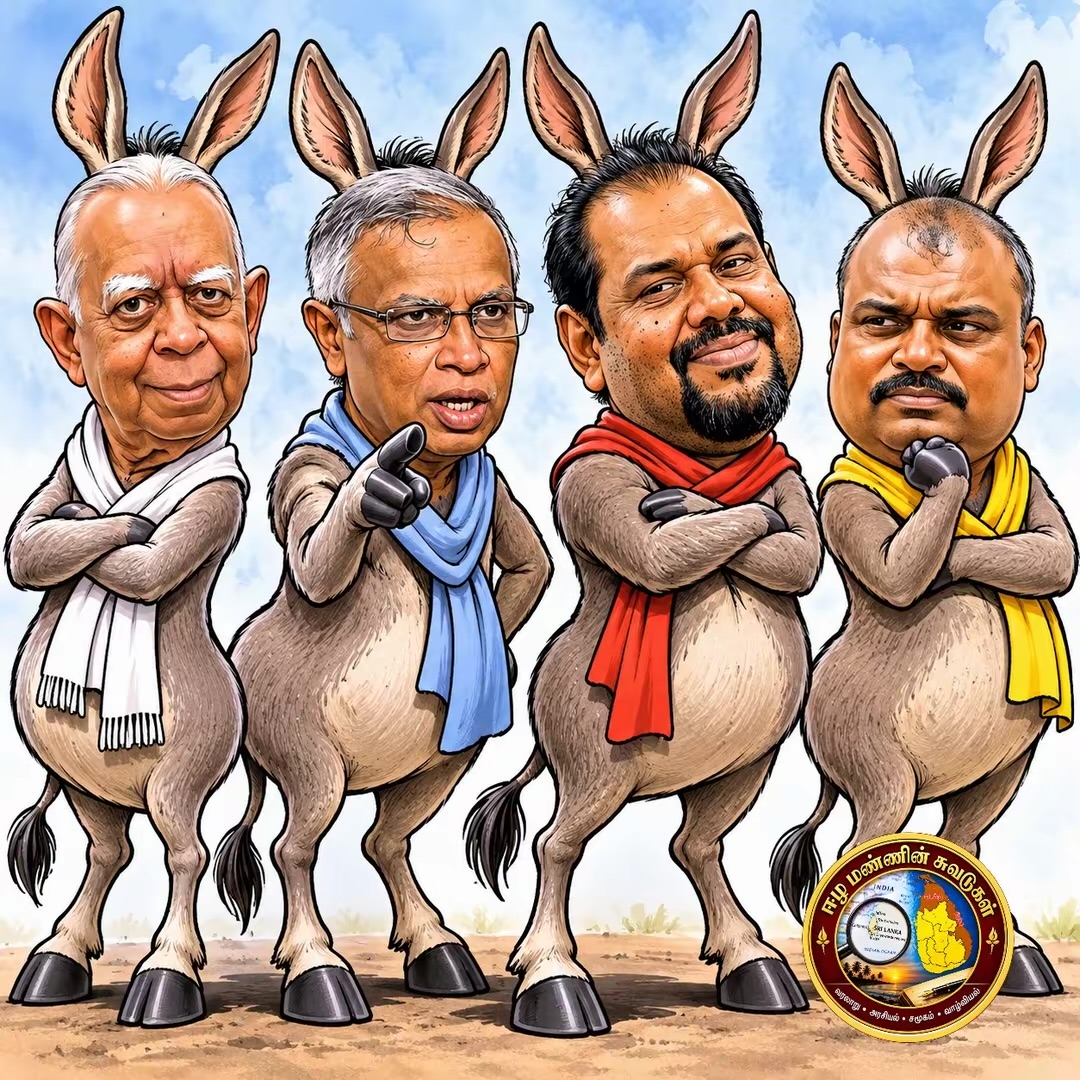
The Other Side of the Tamil National Alliance’s Politics After 2009!
Swami Shankaranandaa
Opinion
When the armed struggle of the Liberation Tigers of Tamil Eelam came to an end at Mullivaikkal in 2009, the Eelam Tamil people had suffered an unprecedented catastrophe. The enormous responsibility of securing justice for people who had lost tens of thousands of lives, lost their loved ones and become refugees in their own homeland rested with the Tamil National Alliance led by Sampanthan, who represented the Eelam Tamil people at that time.
Although Gajendrakumar and Gajendran disregarded that responsibility and broke away from the Alliance after Gajendrakumar’s party was not given the nominations he requested for the 2010 general election,
Sampanthan still had a duty to fulfil that responsibility. He brought Sumanthiran in to fill Gajendrakumar’s place and gave him a place on the National List.
Instead of continuing to fulfil that responsibility, they placed their faith in negotiations with Mahinda Rajapaksa’s government and in a politics of compromise.
The negotiations that began in 2011 went through 18 rounds without delivering any political solution. The talks stalled when the government failed to respond properly to the Alliance’s proposals, and, in my view, they ended as nothing more than a political charade designed to deceive.
At least after the negotiations failed, Sampanthan and Sumanthiran should have united the Tamil people and launched a sustained, non-violent popular struggle. Instead, they gave priority to Colombo-centred politics.
A satirical story comes to mind here.
In a forest, some lions spared a donkey they had captured and sent it back to its herd.
Returning with the lions’ support, the donkey presented itself as the king of the other donkeys. But whenever the lions grew hungry, it led donkeys from its own herd to them.
Although it was king within its own herd, that donkey was never a lion before the lions. Finally, when it became useless to them, it too became their prey.
I am not comparing the Tamil people to the herd of donkeys in this story. I am comparing the political approaches of Sampanthan, Sumanthiran, Gajendrakumar and Gajendran to the political role of the donkey that imagined itself a king by relying on the lions’ support.
I criticise the theatre of the Ilankai Tamil Arasu Kachchi, which pursued reconciliation politics with Sinhala rulers instead of turning the political power gained through Tamil votes into a strong struggle for those people’s rights,
and the role played by the Tamil Congress, which, through its obstinacy, undermined Tamil unity and fragmented Tamil nationalism.
There is a great difference between being a leader sustained by the Tamil people’s trust and being a leader who safeguards the interests of those in power.
Although time exposed their double role to the Tamil people,
with the Ilankai Tamil Arasu Kachchi, the backbone of the Alliance, falling into Sumanthiran’s hands,
and politics being conducted through a family party without any willingness to compromise,
I share with you my anguish that Tamil nationalism, built through the sacrifices of the Maaveerar and the tragic deaths of Tamil people, has been made to disappear.
Reader Comments
Loading comments…