
ARTICLES · GENERAL
Maaveerar Commemorations Must Not End as Mere Events!
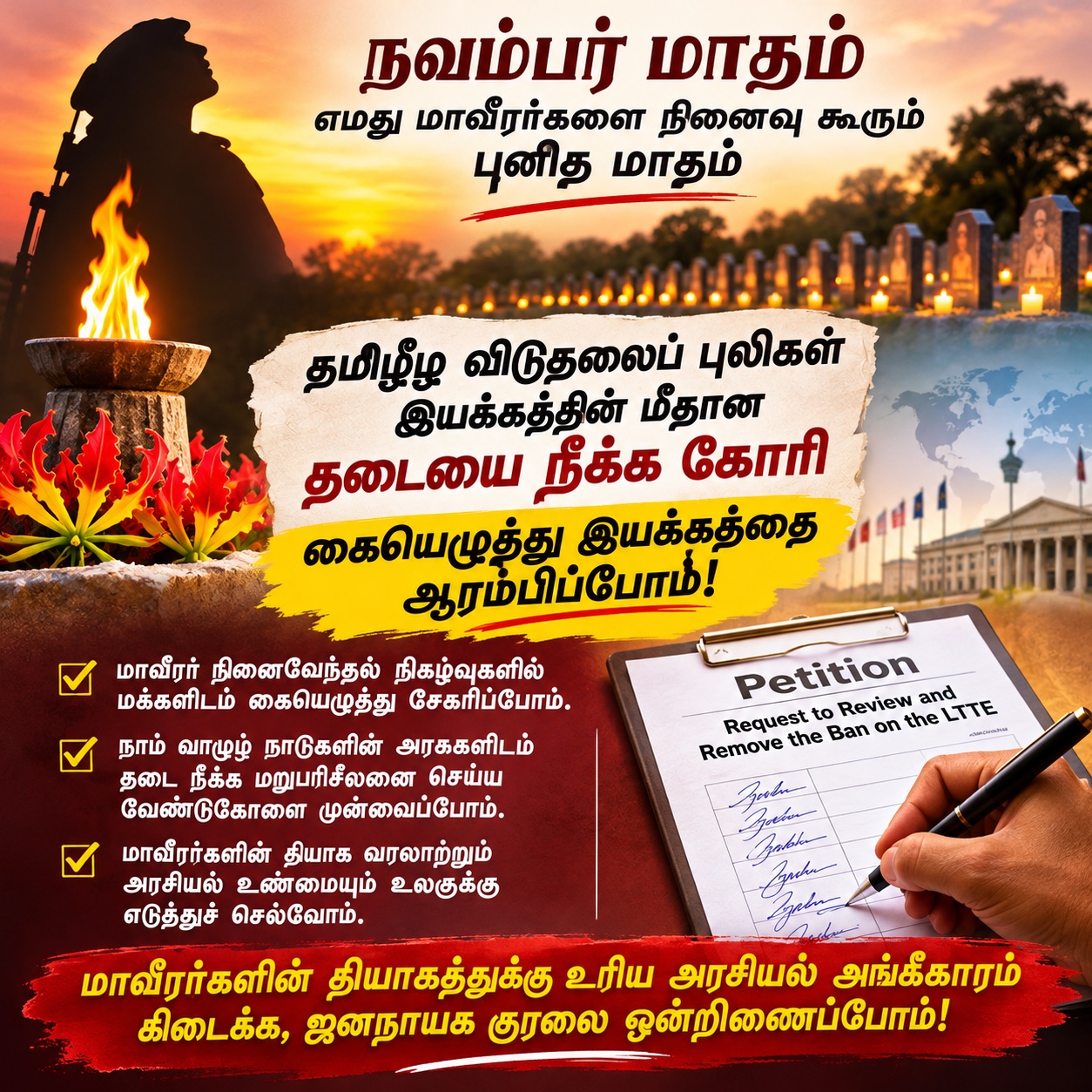
Why Is a Signature Campaign Calling for the Removal of the Ban on the LTTE Necessary?
A Question to the Conscience of Diaspora Tamil Organisations During Maaveerar Month!
Swami Shankaranandaa
Editor-in-Chief – Eelam Mannin Suvadugal
November 5, 2026
My dear Eelam Tamil brothers and sisters living across the world!
Another November has arrived.
In the history of the Eelam Tamils’ liberation struggle, November is more than a month that comes and goes on the calendar. It is the month in which we remember the Maaveerar who dedicated their lives to the dawn of the Tamil Eelam homeland and who live forever in our hearts.
Every year, November 26 marks the birthday of Velupillai Prabhakaran, the national leader of the Liberation Tigers of Tamil Eelam, and November 27 is observed as Maaveerar Day.
This year, too, Maaveerar Day commemorations are to be held by various organisations in Canada, Britain, France, Germany, Switzerland and many other countries.
On the same day, commemorations take place across many countries, in different cities within a country and, in some places, through different organisations even within the same city.
Halls are decorated. Portraits of the Maaveerar are displayed. The common flame is lit. Flowers are offered. Moving commemorative speeches are delivered.
Thousands of Tamil people attend these commemorations with their families.
Families who lost their children, siblings and relatives in the homeland continue to carry those memories with them in the countries to which they have migrated.
Words alone cannot explain the pain, loss and sense of sacrifice in their hearts.
Remembering the sacrifices of the Maaveerar and passing their history on to the next generation are part of preserving our people’s historical memory.
But here, each of us must ask ourselves a question.
To what extent are the Maaveerar commemorations that bring thousands of people together every year being used to advance our people’s political rights?
Does our responsibility end with remembering the sacrifices of the Maaveerar?
Or do we also have a responsibility to bring the historical background of those sacrifices and the Tamils’ political demands before the governments of the countries in which we live, through democratic means?
I am not raising this question for the first time today.
On November 1, 2025, I made an appeal to Eelam Tamils around the world and to the organisations arranging Maaveerar Day events.
That appeal was to collect signatures from Tamil people gathering at Maaveerar commemorations and democratically request the governments of the countries in which we live to review and remove the ban on the Liberation Tigers of Tamil Eelam.
A year has passed.
Yet the request I put forward has not so far been taken up as a coordinated undertaking by diaspora Tamil organisations.
Therefore, during Maaveerar Month in 2026, I am making the same appeal once again.
This is not a request made to promote an individual’s name or increase an organisation’s influence.
I regard it as a democratic effort to bring the historical background of the Tamil Eelam liberation struggle before governments internationally once again.
The armed struggle of the Liberation Tigers of Tamil Eelam came to an end at Mullivaikkal in May 2009.
Seventeen years have passed since then.
However, the Liberation Tigers of Tamil Eelam continues to appear on the lists relating to terrorist organisations maintained by Canada, the United States, Britain and the European Union.
In India, too, the ban on the organisation continues under the Unlawful Activities (Prevention) Act.
The legal grounds for these bans and the procedures for removing them differ from country to country.
Nevertheless, with seventeen years having passed since the end of the armed struggle, it is my view that we should exercise our democratic right to request a review of those bans in light of present circumstances.
It is also my position that the origins of the Liberation Tigers of Tamil Eelam and its armed struggle cannot be considered separately from the political oppression faced by Tamils in Sri Lanka.
The Tamil Eelam armed struggle emerged from the continuing denial of language rights, ethnic violence, struggles for political rights and attacks on non-violent protests that Tamils faced from 1956 onwards.
Before that, under the leadership of Thanthai Chelvanayakam, Tamils had struggled non-violently for their political rights for many years.
It was in circumstances where the Tamils’ fundamental political problems remained unresolved even after those struggles that the idea of armed struggle gained ground among young people.
The countries of the world must fully understand this historical background.
At the same time, there are legal allegations concerning violence during the armed struggle and reasons given for the bans. Rather than concealing these, we must seek a review by presenting the history and current circumstances through the appropriate legal procedures.
An assessment of an armed movement’s past activities and the legal question of whether a ban on it should continue in present circumstances both require thorough examination.
Public signature petitions can be one avenue towards this.
I do not claim that such petitions will immediately remove the ban.
But it is my firm belief that they can help bring public opinion to the attention of governments, begin discussions with members of parliament and emphasise the need to review the ban.
That is why I urged the launch of this signature initiative last year. I urge it again this year.
Dear brothers and sisters!
There is another important matter we must consider here.
Diaspora Tamil organisations have the capacity to bring thousands of Tamil people together for Maaveerar commemorations.
They can obtain large halls. They can coordinate hundreds of volunteers. They can meet the costs of events. They can organise cultural programmes and commemorative speeches.
Why should they not come forward to use that same capacity and coordination to collect petition signatures voluntarily from Tamil people and submit them to governments?
This is not a call for unlawful armed activity.
It is an effort through which people can express their views peacefully and democratically and request a government to reconsider a decision.
Signatures can be collected at Maaveerar commemorations in Canada, and a request for a legal review can be put before the Canadian government and members of parliament.
In Britain, a request can be submitted to the relevant government departments under the legal procedures available there.
In European Union countries, including France and Germany, a review can be urged through the relevant institutions of the European Union.
In Switzerland and India, avenues under the laws of those countries can be explored and democratic requests can be put forward.
Advice can also be obtained from people familiar with the laws of each country.
There is no need to use an identical petition in every country. Petitions can be prepared to suit each country’s legal position and political circumstances.
But the underlying purpose must be the same.
That purpose is to seek a review of the ban on the Liberation Tigers of Tamil Eelam in light of present circumstances.
Why should organisations conducting Maaveerar commemorations not adopt such a clear initiative, which can be pursued democratically, as one of their important tasks?
What better opportunity is there to turn a gathering of thousands of people into the fulfilment of a historical responsibility?
It is here that my question about the responsibility of organisations conducting Maaveerar commemorations arises.
Every year, considerable money and human effort are spent on Maaveerar commemorations.
I do not deny that there are costs involved in conducting events.
There are also good-hearted people among us who work for Maaveerar commemorations without any personal expectations.
I respect their dedication.
But those who run organisations in the name of the memories of the Maaveerar and Tamil national sentiment also have a responsibility to explain to the public the political value of their activities.
We bring people together in the name of the Maaveerar.
We speak about their sacrifices.
We remember their political ideals.
But if we do not undertake even one effort to bring the historical and political demands associated with those memories before governments through democratic means, what is the political purpose of such commemorations?
When organisations do not undertake even these democratic efforts that can be pursued in good faith, how can they prevent people from asking whether their commemorations are becoming merely a means of raising money and building personal names and reputations?
In raising this question, I am not accusing every organisation.
But organisations operating in the name of commemorative events must conduct their activities transparently and responsibly.
Respecting people’s feelings should not end with inviting them to commemoration halls each year.
Organisations must also recognise their responsibility to bring those people’s political views and democratic demands before the appropriate authorities.
What I emphasise here is neither competition between organisations nor personal contests for leadership.
Rather, I emphasise the need to work together for a common democratic demand.
Today, various organisations in the diaspora Tamil community conduct Maaveerar commemorations separately.
In some places, differences of opinion and competition between organisations divide these events.
People remembering the same history stand divided across different halls.
These divisions must not weaken the common voice advancing our people’s political demands.
More important than which organisation conducts a Maaveerar commemoration should be how we advance our people’s history and political rights through that commemoration.
Even if organisations remain separate, they can find a way to work together with a shared purpose in a lawful signature initiative.
Each organisation can collect signatures voluntarily at its events and submit them to governments with appropriate legal advice.
They can openly inform the public of the responses received from governments regarding those petitions and of progress in the review procedures.
This can create a connection between commemorative events and continuing democratic political activity.
Dear brothers and sisters!
There is another matter I wish to emphasise during this Maaveerar Month.
Those who hold Tamil national sentiment honour November as the month set aside to remember our Maaveerar.
It is my wish that events honouring their memory receive the importance they deserve during this month.
We must ensure that the fundamental purpose of commemorations is not obscured by mixing them with unrelated programmes or activities promoting personal fame.
Commemoration halls must not become stages for displaying personal political influence.
While claiming to honour the sacrifices of the Maaveerar, we must also avoid using their memories for competition between organisations.
The significance of Maaveerar Month must be explained to younger generations.
The history of the Tamils’ struggle for political rights, the human losses associated with it, the non-violent struggles, the period of armed struggle and the Mullivaikkal catastrophe must be explained with authentic historical evidence.
Passing history to the next generation means more than transmitting emotion alone.
It must mean explaining the causes of that history, its consequences and the lessons we must learn from it.
That will form the foundation for future generations to advance their people’s political rights knowledgeably and democratically.
After 2009, the political struggle of Eelam Tamils entered a new context.
Today, in the countries in which we live, there are opportunities to meet members of parliament, submit petitions to governments, work with human rights organisations and use legal avenues.
What is needed today is to make proper use of these opportunities.
Each year that we remember the Maaveerar, we must advance more clearly the people’s demands for political rights associated with those memories.
The petition initiative I propose can be a beginning towards that.
Putting forward this request is not an attempt to justify past violence. It is a call, through democratic means, to reconsider the legal necessity of continuing a ban in the present circumstances following the end of the armed struggle.
We must understand this distinction clearly and act accordingly.
The legal decision to remove the ban on the Liberation Tigers of Tamil Eelam can be made only by the governments and judiciaries of the respective countries through the appropriate procedures.
But diaspora Tamil people and the organisations that claim to represent them can play a part in raising a democratic voice calling for that review.
Why leave that opportunity unused?
This is why I am reiterating this year the appeal I made last year.
Maaveerar commemorations take place every year.
Organisations and organisers change.
Halls, stages and decorations change.
But our people’s unresolved political problems continue.
In these circumstances, the need to pursue democratic political initiatives connected with commemorations must no longer be ignored.
Therefore, I once again make my appeal to organisations conducting Maaveerar commemorations in countries including Canada, Britain, France, Germany, Switzerland and India.
Please consider launching a signature petition initiative, with the voluntary participation of those attending this year’s Maaveerar commemorations, calling for a review and removal of the ban on the Liberation Tigers of Tamil Eelam.
Pursue this request democratically, within the laws of the respective countries and with appropriate advice.
Regard the signatures obtained from the public not merely as numbers, but as a responsibility to bring their views to the attention of governments.
Give importance to the people’s common political demands rather than promoting organisations’ names and leaders’ reputations.
Preserve the respect due to the memories of the Maaveerar, without entangling them in competition between organisations.
It is my wish that this appeal, which I made last year, should at least be put into action this year.
Tamil nationalism is more than shouting slogans on stages or delivering emotional speeches at commemorations.
It also means acting honestly and responsibly to protect the history and political rights of the Tamil people.
Remembering the Maaveerar may honour their past sacrifices. But advancing the political demands of the people behind those sacrifices through peaceful democratic means must also be the responsibility of the present generation.
It is my position that merely conducting commemorative events year after year, without recognising that responsibility, is insufficient.
More than setting up stages in the name of the Maaveerar, what is needed today is action to advance democratically the political demands connected with their history.
Maaveerar commemorations must not end as mere events. They must also open the way for democratic efforts that bring the people’s political views before governments.
It is my firm view that a public signature initiative calling for a review of the ban on the Liberation Tigers of Tamil Eelam can be one such avenue.
Pursuing this effort in good faith, in unity and lawfully is the path of sincere Tamil nationalism in which I believe.
I once again humbly ask organisations arranging Maaveerar commemorations around the world to take this into consideration and act.
May our respect for the memories of the Maaveerar endure forever!
May the democratic voice for the political rights of the Tamil people continue to be heard!
Swami Shankaranandaa
Editor-in-Chief
Eelam Mannin Suvadugal
Reader Comments
Loading comments…