
ARTICLES · GENERAL
Humanity Is Greater Than Religion! Some Questions to My Muslim Friends About Children’s Rights and the Death Penalty!
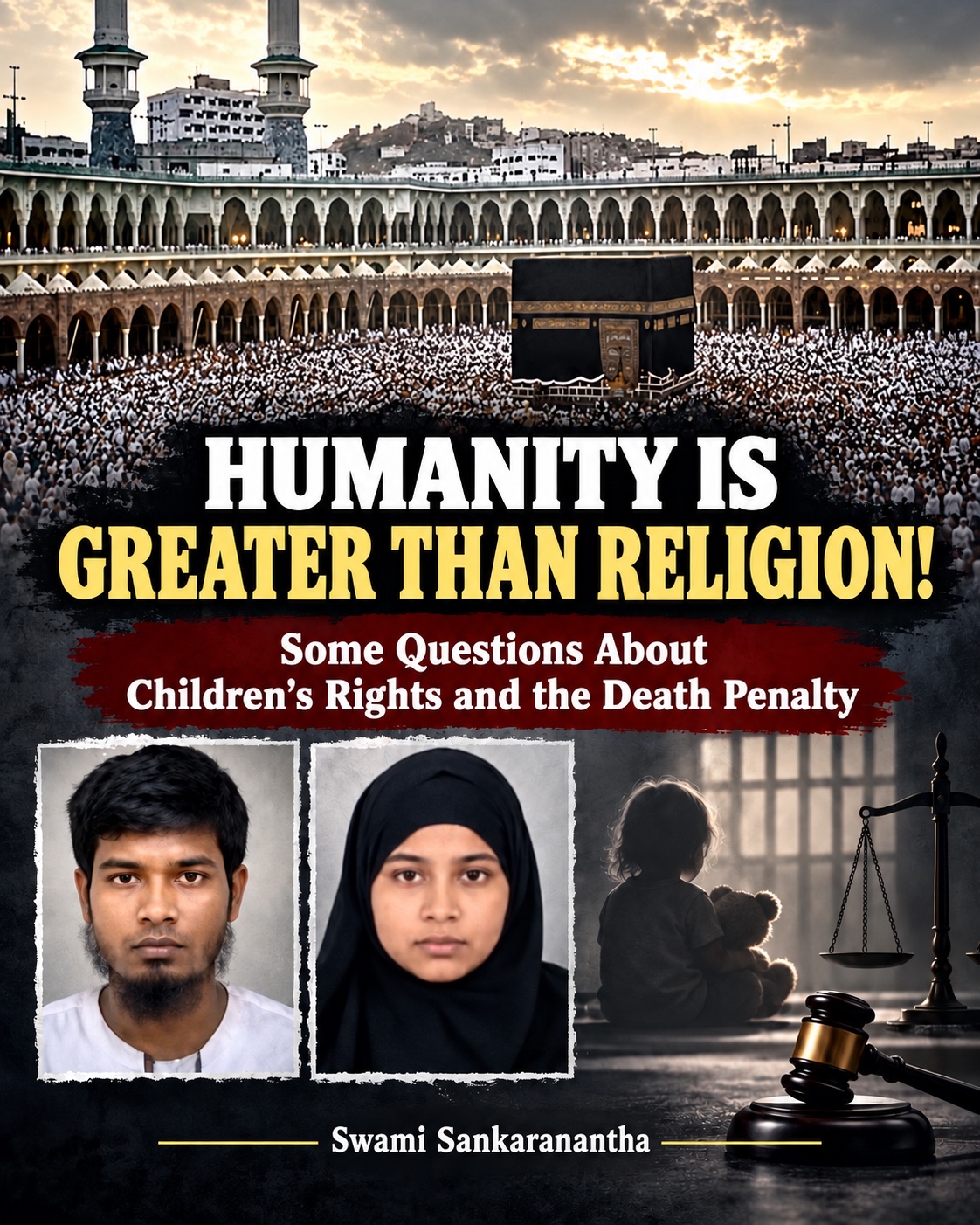
Swami Sankaranantha
Dear Tamil-speaking Muslim friends!
In response to my earlier post, “Two Bangladeshi Nationals Sentenced to Death in Saudi Arabia under ‘Taʿzir’,” a Muslim like yourselves, named Mazin Need,
argued that Islam cannot be held responsible for the crimes of individuals and that Islamic law had upheld justice by imposing the death penalty on the offenders.
He also said that Islam gives priority to women’s wishes, referred to Aisha’s chastity and learning, and warned me that I would face God’s severe questioning in the afterlife, expressing his views to me in those terms.
As I was also able to see many comments posted on social media by other Muslims who, like him, supported those death sentences,
I present the reply I gave him as my opinion to you, my Muslim friends who think as he does, and I look forward to hearing your views as well.
Dear friends!
In my earlier post, I did not question Aisha’s chastity or learning. My point was to draw attention to reports 5133 and 5134 in Sahih al-Bukhari, regarded as an important hadith collection in Sunni Islamic tradition, which state that Aisha married the Prophet Muhammad when she was six and that the marriage was consummated when she was nine.
When such an account of the life of Muhammad, who is regarded as a guide to Islam and an example for Muslims to follow, appears in your own religious text, how is it wrong to question it on the basis of present-day child protection and humanity?
If, like Mazin Need, you too say that Islam gives priority to women’s wishes, are you saying that Aisha, a six-year-old child, could have given full, free and informed consent to marry Muhammad, who was over 50?
Would a six-year-old child have had the maturity to understand what marriage means, what responsibilities it involves, and what its physical and psychological consequences are?
Do you accept today’s basic ethical principles concerning child protection and consent to marriage?
Or do you believe that ancient religious traditions permitting child marriage should still be followed today?
If you too say, “I am a Muslim following a faith that follows the teachings and guidance of the Messenger of God, the Prophet Muhammad,” would you follow the example described in the hadith about your Prophet’s life and arrange the marriage of your six-year-old daughter to someone over 50?
Please answer this question directly: is it right or wrong?
How can an act you would not accept in your own child’s life be justified only when it is associated with the life of someone regarded as a religious guide?
Does an act become an ethical principle suitable for all time simply because it is said to have happened 1,400 years ago or because it appears in a religious text?
Under present-day child-protection principles, a six-year-old child cannot give informed consent to marriage. Nor can an adult having sexual relations with a nine-year-old child be justified in the name of the child’s consent.
This is a basic ethical principle that applies not only to Muslim children but also to Hindu, Christian, Buddhist and children of every religion.
Dear friends!
In Book 86 of the same Sahih al-Bukhari, hadith 6848 appears in the section concerning “Taʿzir and disciplinary punishment.”
It records Muhammad as saying that no more than ten lashes should be administered for offences other than those for which punishment has been prescribed by Allah.
Thus, the statement concerning disciplinary punishment is also attributed to the same Muhammad whom your hadith collection describes as having married a six-year-old child.
Taʿzir is a system in Islamic law under which a judge or ruler exercises discretion in imposing punishment for offences for which no specific penalty has been prescribed.
Islamic legal scholars hold differing views about the limits of this system of punishment. Some have interpreted it as permitting the death penalty for certain serious offences.
However, Sahih al-Bukhari 6848 does not directly state that the death penalty should be imposed in the name of Taʿzir.
Against this backdrop, reports have stated that two Bangladeshi nationals were executed under Taʿzir in the Mecca region of Saudi Arabia on October 14, 2026.
They had been accused of committing an indecent act in a mosque. Saudi Arabia’s Interior Ministry announced that the accusation had been proven and that the death penalty had been imposed in view of the seriousness of the offence and respect for the sacred site.
However, Saudi authorities have not publicly released full details of the act they were alleged to have committed. Nor have adequate explanations been provided in response to important questions such as what legal assistance they received and how transparently the proceedings were conducted.
In these circumstances, how can the taking of two human lives be presented as proof that Islamic law has upheld justice?
Does the death penalty become justified simply because the place where the offence allegedly occurred is sacred?
Without examining the nature of the offence, the evidence against the accused, the fairness of the proceedings and the severity of the punishment, can a sentence be celebrated as a victory for justice merely because it was imposed in the name of religious law?
Which hadith of Muhammad directly commands the imposition of the death penalty under Taʿzir?
How do you justify the taking of human lives on the basis of interpretations offered by some Islamic legal scholars as the justice of Islam as a whole?
The question I am asking you here is a very simple one.
If, on the basis of present-day child-protection principles, you would not follow in your own children’s lives the practice recorded in the hadith concerning Muhammad’s married life, how do you justify imposing the death penalty on human beings in the name of religious laws that developed on the basis of the guidance of that same Prophet?
Furthermore, when hadith 6848 concerning Taʿzir does not directly state that the death penalty should be imposed, how do you celebrate the taking of two human lives on the basis of legal interpretations developed later as the establishment of Islamic justice?
If you accept present-day humanitarian principles for protecting children, why do you justify a punishment that takes human lives solely in the name of religion?
Although both are accounts in hadith collections concerning the life and teachings of the same person, they concern different matters. My question, however, is why you make a decision on the basis of present-day humanity in one matter but, in the other, place interpretations of ancient religious laws above human lives.
Furthermore, if, like Mazin Need, you too believe that God will impose punishment in the afterlife, I would like to ask you another question.
Did it not occur to you that, instead of executing those two Bangladeshi nationals, the final punishment for the offences they were alleged to have committed could have been left to your God in the afterlife?
Why do you invoke punishment in the afterlife to condemn me, but justify the death penalty when it comes to punishing them?
This is the contradiction between your religious belief and your argument about punishment!
I do not oppose bringing offenders before the law or imposing appropriate punishment on them. But I cannot accept celebrating the taking of their lives as a victory for justice while denying them the opportunity to reform and live.
If justice means taking a person’s life because he has done wrong, what does humanity mean?
Can a person who has done wrong not be reformed? Are there no alternatives, including imprisonment, through which he can be punished? Must taking a human life be the ultimate solution?
Dear friends!
I accept your view that an entire religious community cannot be held responsible for a crime committed by an individual belonging to that religion.
However, when a government takes human lives in the name of religion, the basis of that law and the religious justifications offered for it cannot be left unquestioned.
If you say that an individual’s crime has nothing to do with religion, why do you present the death penalty imposed on that same individual under religious law as proof that religion has upheld justice?
If responsibility for the crime lies with the individual, should the justice of the punishment not be assessed on the basis of that offence? Why is there a need to celebrate it as a source of religious pride?
Religious belief is an individual right. A person may follow any religion, worship their God and regard their religious texts as sacred.
However, the laws and ethical principles advanced in the name of that belief are not beyond criticism.
These questions of mine are not intended to take away your personal religious beliefs or to insult Muslim people.
I raise them on the basis of my humanitarian conviction that children’s rights and the value of human lives must be protected.
Humanity is greater than religion. Children’s safety is more important than religious beliefs.
Therefore, do not commit a wrong against society by supporting, in the name of religion, cruel state laws that take human lives by turning ideas expressed 1,400 years ago—when people had not attained today’s level of civilizational development—into law, even when those ideas conflict with present-day humanity and fundamental rights.
Religion should guide people towards living well and help those who have done wrong to reform and live, rather than guide others to kill them.
Humanity that seeks to save those lives is greater than a religious belief that celebrates the taking of human lives as justice.
Swami Sankaranantha 🙏
Reader Comments
Loading comments…