
canada
A New Turning Point in Canada–EU Relations: Prime Minister Mark Carney Holds Key Talks with European Leaders in Montreal
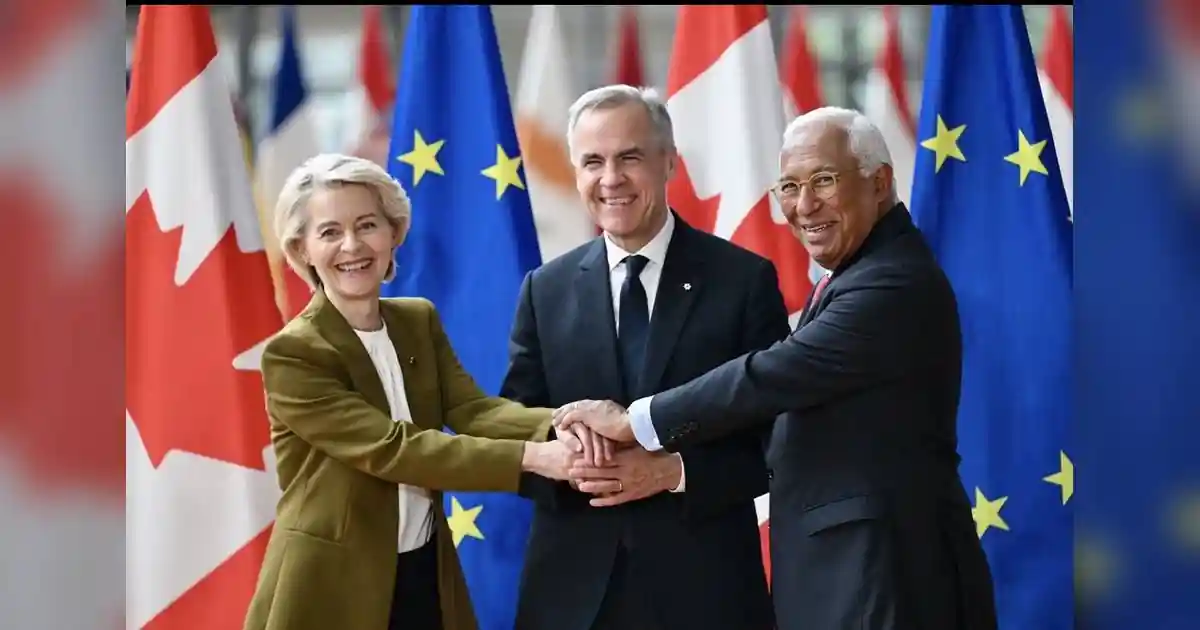
Canadian Prime Minister Mark Carney is set to welcome high-level European Union leaders to Montreal to strengthen economic, trade, security and political ties between Canada and the EU.
The two-day meeting, scheduled for Thursday, October 29, and Friday, October 30, 2026, is described as the 21st summit between Canada and the European Union, which comprises 27 member states.
European Commission President Ursula von der Leyen and European Council President António Costa will attend. A Canadian delegation led by Prime Minister Carney will conduct the talks.
Amid uncertainty in trade relations with the United States, Canada is prioritizing expanded economic cooperation with European countries.
In particular, the trade policies and tariffs of US President Donald Trump have created economic pressures that have increased Canada's need to diversify its markets.
Against this background, the Montreal summit is seen as a significant development in Canada's international trade and foreign policy.
A New Partnership for the Future
A central aim of the summit is the creation of a new framework for cooperation between Canada and the EU, described as a partnership for the future.
The partnership is intended to expand relations in trade, technology, energy, security, education, research and investment.
The leaders will explore ways of combining Canada's natural resources, critical minerals, energy resources, expertise in artificial intelligence and aerospace technologies with the EU's large market and industrial strength.
In particular, increasing cooperation in the production and supply of critical minerals used in electric-vehicle batteries, modern electronics and defence manufacturing will be an important part of the discussions.
Will Canada Receive Special Status in the EU?
Ahead of the summit, Ursula von der Leyen had suggested the possibility of granting Canada a special form of associated status with the European Union.
However, the EU's current legal framework does not provide for a separate membership category of this kind. Some European countries have expressed opposition and doubts about the idea.
There are therefore no current negotiations to make Canada a full EU member.
Rather, the discussions concern a new model of closer cooperation that goes beyond existing trade agreements.
Prime Minister Carney has said that practical benefits for Canadians and their businesses matter more than the name given to the partnership.
Canada–EU Trade
The EU is Canada's second-largest international trading partner.
The combined value of goods and services traded between Canada and the European Union in 2025 was approximately C$178 billion.
Trade has grown substantially since the Canada–EU Comprehensive Economic and Trade Agreement came into effect in 2017.
Canadian government information indicates that merchandise trade has increased by more than 78 percent compared with the pre-agreement level.
The summit will also address making greater use of the agreement to lower barriers, encourage investment and expand technology exchanges.
Security and Defence Cooperation
Security ties between Canada and the EU will also occupy an important place at the summit.
A partnership for security and defence cooperation was established at the bilateral summit held in June 2025.
Canada subsequently became the first country outside Europe to participate in the EU's SAFE initiative, which promotes investment in the defence industry.
This is expected to create new opportunities for Canadian defence companies in the European market.
The leaders will also discuss support for Ukraine, measures against Russia, Arctic security, the situation in the Middle East and international security challenges.
New Opportunities in Education, Employment and Youth Development
Expanding opportunities for young people, students and skilled workers will also be a priority.
Possible Canadian participation in the EU's Erasmus+ student exchange programme has already been under discussion.
Participation could increase opportunities for Canadian students to study and train in European countries and for European students to access new opportunities in Canada.
However, Canadian officials have clarified that the negotiations are not intended to establish unrestricted freedom for all workers to move between Canada and European countries for employment.
Instead, the focus is on making mobility easier for qualified workers in certain sectors.
A New Agreement with the European Investment Bank
Canadian Minister of Finance and National Revenue François-Philippe Champagne will also participate in economic events connected with the summit.
A signing ceremony for a new framework cooperation agreement is scheduled for October 30, together with European Investment Bank Vice-President Nicola Beer.
The agreement is expected to generate investment opportunities in sectors important for Canada's economic growth, including critical minerals.
Disagreement Between Quebec's Premier and the Federal Government
The international summit in Montreal has also created a political disagreement between Canada's federal government and Quebec's provincial government.
Quebec Premier Paul St-Pierre Plamondon had requested an opportunity to speak before European leaders at the summit.
When that request was not accepted, he decided not to attend.
He criticized the refusal to let the premier address the gathering as disrespectful, given that talks concerning Quebec's economic interests were being held on its territory.
Prime Minister Carney, meanwhile, said the premier had been invited to a reception with the European leaders.
Quebec's Minister of International Relations, Pascale Paradis, will represent the province instead.
Could a Comprehensive Agreement Be Reached in 2027?
The two-day Montreal summit is not expected to settle every issue.
Instead, its main purpose is to launch formal discussions toward creating a new Canada–EU partnership.
These talks are expected to continue for about a year, with efforts to conclude a comprehensive agreement at the Canada–EU summit in 2027.
The initiative could help Canada diversify its trade away from heavy dependence on the United States while establishing long-term economic and security cooperation with European nations.
However, agreement is still needed on the new partnership's legal structure, financial obligations, worker mobility and market access.
The joint statement expected at the conclusion of the summit on October 30 may therefore be a key document setting out the next stage in relations between Canada and the European Union.
Reader Comments
Loading comments…